This document is for a deprecated release of Opendaylight and will receive only security updates.
Key distribution in a scaled network has always been a challenge. Typically, operators must perform some manual key distribution process before secure communication is possible between a set of network devices. The Secure Network Bootstrapping Infrastructure (SNBI) project securely and automatically brings up an integrated set of network devices and controllers, simplifying the process of bootstrapping network devices with the keys required for secure communication. SNBI enables connectivity to the network devices by assigning unique IPv6 addresses and bootstrapping devices with the required keys. Admission control of devices into a specific domain is achieved using whitelist of authorized devices.
At a high level, SNBI architecture consists of the following components:
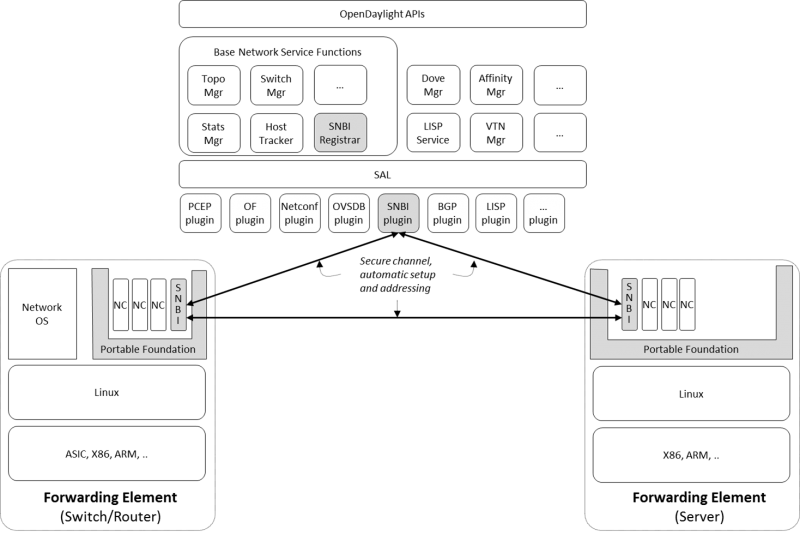
SNBI Architecture Diagram
Registrar is a device in a network that validates device against a whitelist and delivers device domain certificate. Registrar includes the following:
RESTCONF API for Domain Whitelist Configuration:.
RESTCONF APIs are used to configure the whitelist set device in the registrar in the controller. The registrar interacts with the MD-SAL to obtain the whitelist set of devices and validate the device trying to join a domain. Furthermore it is possible to run multiple registrar instances pertaining to each domain.
SNBI Southbound Plugin:.
The Southbound Plugin implements the protocol state machine necessary to exchange device identifiers, and deliver certificates. The southbound plugin interacts with MD-SAL and the certificate authority to validate and create device domain certificates. The device domain certificate thus generated could be used to prove the validity of the devices within the domain.
Certificate Authority:.
A simple certificate authority is implemented using the Bouncy Castle package. The Certificate Authority creates the certificates from the device CSR requests received from the devices. The certificates thus generated are delievered to the devices using the Southbound Plugin as discussed earlier.
The SNBI Forwarding Element runs on Linux machines which have to join the domain. The Device UDI(Universal Device Identifier) or the device identifier could be derived from a multitude of parameters in the host machine, but most of the parameters derived from the host are known ahead or doesn’t remain constant across reloads. Therefore, each of the SNBI FE should be configured explicitly with a UDI that is already present in the device white list. The registrar service IP address must be provided to the first host (Forwarding Element) to be bootstrapped. As mentioned in the section_title section, the registrar service IP address is fd08::aaaa:bbbb:1. The First Forwarding Element must be configured with this IPv6 address.
The forwarding element must be installed or unpacked on a Linux host whose network layer traffic must be secured. The FE performs the following functions:
Neighbour Discovery (ND) is the first step in accommodating devices in a secure network. SNBI performs periodic neighbour discovery of SNBI agents by transmitting ND hello packets. The discovered devices are populated in an ND table. Neighbour Discovery is periodic and bidirectional. ND hello packets are transmitted every 10 seconds. A 40 second refresh timer is set for each discovered neighbour. On expiry of the refresh timer, the Neighbour Adjacency is removed from the ND table as the Neighbour Adjacency is no longer valid. It is possible that the same SNBI neighbour is discovered on multiple links, the expiry of a device on one link does not automatically remove the device entry from the ND table. In the exchange of ND keepalives, the device UDI is exchanged.
Bootstrapping a device involves the following sequential steps:
A device which is already bootstrapped acts as a proxy to bootstrap the new device which is trying to join the domain.
Host configuration involves configuring a host to create a secure overlay network, assigning appropriate IPv6 address, setting up GRE tunnels, securing the tunnels traffic via IPsec and enabling connectivity via a routing protocol. Docker is used to package all the required dependent software modules.
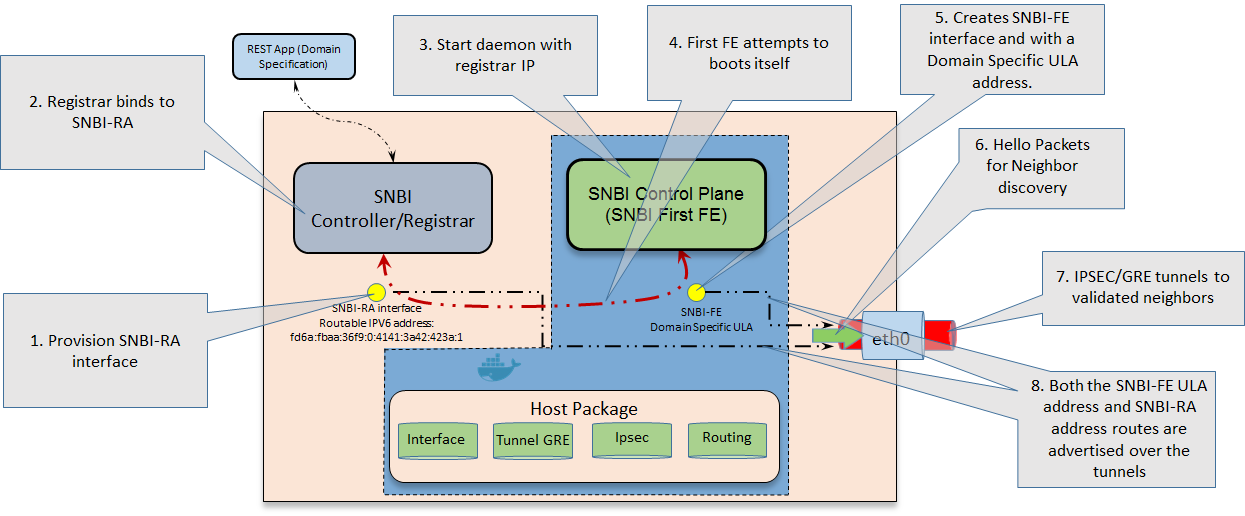
SNBI Bootstrap Process
The SNBI Forwarding Element is packaged in a docker container available at this link: https://hub.docker.com/r/snbi/boron/. For more information on docker, refer to this link: https://docs.docker.com/linux/.
To update an SNBI FE Daemon, build the image and copy the image to /home/snbi directory. When the docker image is run, it autoamtically generates a startup configuration file for the SNBI FE daemon. The startup configuration script is also available at /home/snbi.
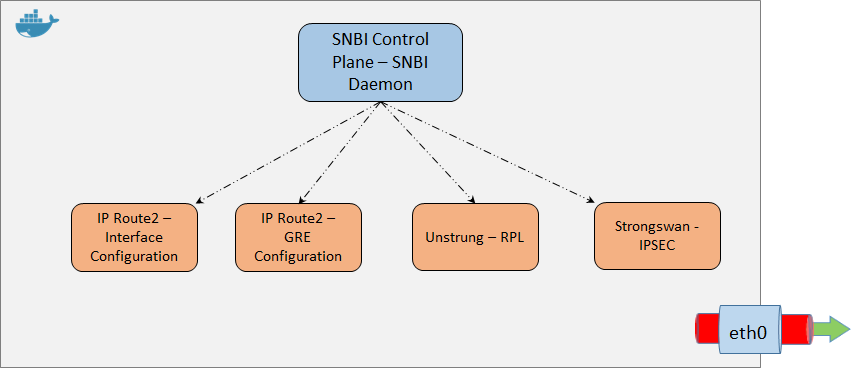
SNBI Docker Image
The only API that SNBI exposes is to configure the whitelist of devices for a domain.
The POST method below configures a domain - “secure-domain” and configures a whitelist set of devices to be accommodated to the domain.
{
  "snbi-domain": {
    "domain-name": "secure-domain",
    "device-list": [
      {
        "list-name": "demo list",
        "list-type": "white",
        "active": true,
        "devices": [
          {
            "device-id": "UDI-FirstFE"
          },
          {
            "device-id": "UDI-dev1"
          },
          {
            "device-id": "UDI-dev2"
          }
        ]
      }
     ]
  }
}
The associated device ID must be configured on the SNBI FE (see above).
See the generated RESTCONF API documentation at: http://localhost:8181/apidoc/explorer/index.html
Look for the SNBI module to expand and see the various RESTCONF APIs.
